Reflections on Operationalising Care
Working with limited resources and real risks in small cultural organizations
By Jen Gamboa and Frances Rudgard
Background
In December 2025, Mekong Cultural Hub (MCH) invited three fellows to take part in a Cultural Leaders Pod focused on “Operationalizing Care,” as part of its Cultural Leadership Program. The pod brought together a small group of cultural practitioners from across Southeast Asia, supported through a structured series of group and individual coaching sessions facilitated by MCH Director Frances Rudgard.
The pod was comprised of:
- Jen Gamboa – Manager of the Aurora Artist Residency Program and Space, an independent organization working with grassroots communities in the Philippines
- Monorom Tchaw – Founder of Leng Dei, an educational food garden initiative working with local communities in Cambodia
- Hang Nguyen (Zel) – Director of Hanoi Grapevine, a non-profit organization supporting and promoting arts and culture in Vietnam
While we came from different countries and contexts, we shared a common reality: working within an interconnected Southeast Asian ecosystem of culture, art, society and nature—often with limited resources and under significant pressure. Each of us brought our own experiences, concerns, and aspirations related to operationalizing care within our small cultural organizations.
Through these sessions, we explored ongoing challenges in our work through the lens of care. Some of the questions we sat with included: How to nurture a new community? How do we navigate fear and uncertainty? How do we respond to the constant feeling that there is more to do than what our time and resources allow?
Stories from Practice
Through the collective openness and the sincerity of everyone in the pod, it quickly became a space of trust, reflection, and mutual support. Although our time together was relatively brief—just a few hours over a three-week period—the conversations led to tangible shifts in how we approached our work.
One concern, raised by Jen, centered on working in politically sensitive contexts, particularly in collaboration with Indigenous communities. In the Philippines, even when community work does not have an explicit political agenda, it can be perceived as such, and in some cases, this can lead to “red-tagging,” where individuals or organizations are labelled as being affiliated with insurgent groups. Such labelling can have serious consequences, including heightened scrutiny by the military and threats to safety, which can constrain how organizations operate. This creates a looming sense of fear for the team members, as risks—including the possibility of being red-tagged—are beyond their control.
Through the pod, this concern was reframed as a question of care: how can an organization better support its team in navigating this type of threat to security? One practical step that emerged was to move forward with a long-considered idea to hold a human rights training for team members. Following the sessions, the organization sought international support to fund this training workshop, which helped each member feel better prepared and informed in responding to situations involving security risks.
For Hang, questions of care emerged around leadership, sustainability, and life transitions. With a small team that relies on the organization for income—and with Hang currently leading the work of securing projects that sustain the organization—planning for the future raised important questions: how can care be extended not only to the team, but also to the leader herself? Hang has been considering pursuing a PhD, which could also open up new opportunities for the organization, but has found it difficult to take this step given her current responsibilities. One idea that emerged was the co-creation of human resource policies with colleagues, particularly to help navigate life events and transitions. While this does not fully resolve the challenge, it can begin to open up conversations around shared responsibility, workload distribution, and longer-term sustainability. Another idea that has since taken shape is the team’s decision to move to a new office closer to several team members’ homes and spacious enough to accommodate a baby, reflecting a practical effort to create a working environment where team members can better support one another.
For Monorom, the focus was on nurturing a new, cross-sectoral community of organizations working around ecological concerns. While initial steps had been taken to bring a small group together, the challenge lies in how to build connection and alignment among members with varied personalities and coming from various backgrounds and experiences. Rather than moving quickly into planning, one idea that emerged was to first create space for the group to get to know each other and find a shared rhythm. This involved exploring what unites the members—their motivations, frustrations, and what each can offer—to reveal natural synergies, alongside using participatory approaches that ensure all voices are heard. Here, care was understood as an ongoing practice of attentiveness—creating the conditions for connection, trust, and shared purpose to grow gradually.
Across these different contexts, a common thread emerged: care is about taking practical steps to support people in navigating uncertainty.
What follows are some of the key lessons and reflections that surfaced from our exchanges, along with a set of principles for operationalizing care in small organizations like ours.
Reflections
Working across different contexts in Southeast Asia, we were reminded not only of the differences in our perspectives, but also of how these differences shape the ways we respond to challenges. The strategies and approaches we take are often shaped by our specific histories, worldviews, and constraints. What might feel like an appropriate or necessary response in one setting may not translate in another—for example, in how we deal with politically sensitive issues: whether to speak up more openly from a rights-based approach, or to take a more cautious, relational approach.
These differences did not create conflict, but instead opened up space to reflect on our own assumptions and consider alternative ways of approaching care.
In navigating these differences, we also found ourselves returning to a simple but grounding idea: care is not something we feel—it is something we do.
In practice, this meant making small but deliberate shifts—creating space for conversations, rethinking how responsibility is shared, or finding ways to better prepare for uncertainty. These actions, while modest, can shape how individuals and teams experience support over time.
From this, a few core understandings emerged:
| – Care is a shared responsibility – Care is refusing to individualize risk; it is holding uncertainty collectively – Care is attentiveness – Care is an active, ongoing practice |
Through our discussions, we identified seven principles for operationalizing care in small organizations:
- Allocate resources to support your operations
This involves putting attention into the systems that help the work function more smoothly. In practice, this may include clarifying roles, developing simple policies, or providing support for training that responds to the concerns your team is navigating.
- Name risks and plan for uncertainty
While risks may not always be avoidable, acknowledging them and thinking through possible strategies or responses in advance can help teams feel more prepared when situations arise.
- Share ownership of responsibilities and solutions
Involving others in decisions and problem-solving can create more space for people to contribute and take initiative. When responsibility is shared, leadership can also be more decentralized, allowing different strengths and perspectives to surface, and enabling people to take a more active role in shaping the work.
- Create space for feedback and dialogue
Regular, honest communication is an act of respect; it builds trust and creates a foundation for navigating difficult situations together. This can involve shifting from assumptions to curiosity—asking questions, inviting different perspectives, and learning from one another.
- Invest time in relationships and collaboration
Building habits of collaboration strengthens connection and resilience. In this sense, relationships are not separate from the work—the relationship is the project. Regular check-ins, shared working time, and collaborative problem-solving all contribute to this.
- Stay attentive to people and changing context
Care involves paying attention to how people are doing, how they work best, and what is happening in the wider environment. This includes understanding each person’s needs and rhythms, making these visible within the team, and adjusting plans when they are no longer working. In some cases, this can be as simple as asking: What does care mean to you? How do you best feel supported?
- Care for your own capacity
In small organizations, it is easy to take on too much. Being realistic about what you can do—and being open about it—can help ensure that work remains manageable over time.
Across these principles, one idea remained constant: care is built through everyday actions, decisions, and habits. In our discussions, this often meant taking small but intentional steps, rather than waiting for the “right” conditions. It also meant recognizing that care looks different in each context, and that there is no single formula, only practices that can be adapted over time.
In closing, operationalizing care is not only about responding to moments of crisis—it is built into the everyday ways we work, relate to one another, and share responsibility. Even small actions—clarifying roles, taking time to listen, or creating space for honest dialogue—can help build more caring ways of working in practice.
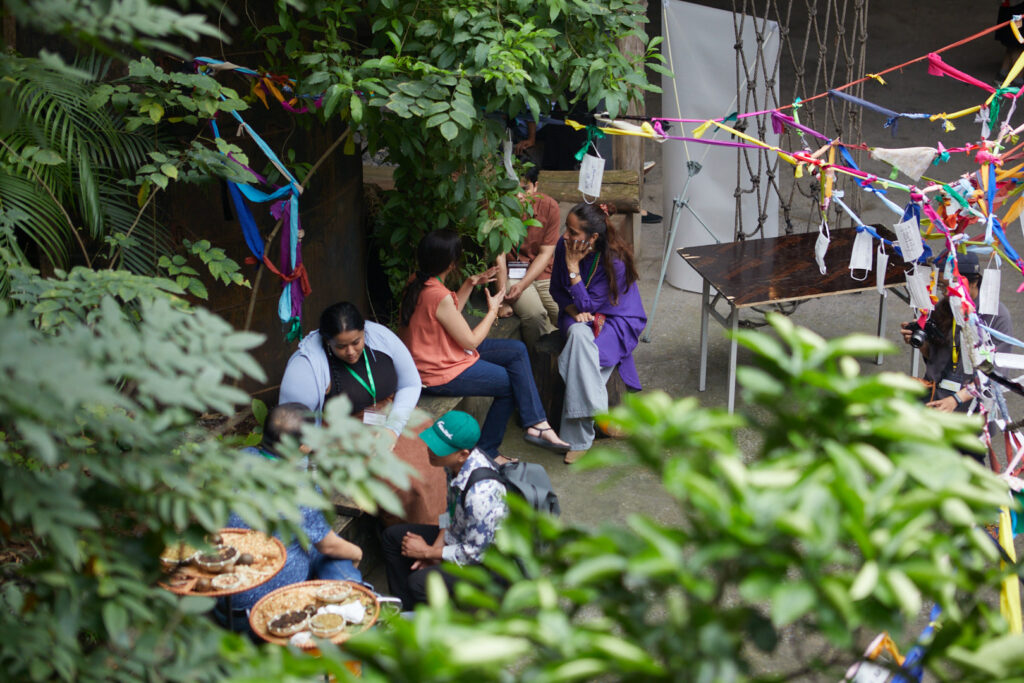
As a pod, we created a temporary space to pause, reflect, and attend to some of these challenges—what one podmate described as a “support circle,” a space for listening, without judgment. This kind of space made it easier to articulate concerns and to hear them reflected back through others’ perspectives.
We hope that this model of structured peer exchange might encourage others to create similar spaces within their own contexts. In doing so, even small steps—taken individually or collectively—can help build more caring ways of working in practice. What is one small step you could take this week to care for your team, your organization, or yourself?